Table of Contents
- What Is Digital Dentistry?
- Key Technologies in Digital Dentistry
- Benefits of Digital Dentistry
- Implementing Digital Workflows
- Challenges and Considerations
- Future Trends in Digital Dentistry
- Conclusion
Digital dentistry is revolutionizing how dental professionals deliver care, from diagnostics to patient interaction. The integration of advanced technologies has led to more efficient workflows, increased procedural precision, and ultimately improved patient satisfaction. For practices that aim to stay at the forefront of the industry, understanding and implementing these innovations is essential. Those seeking to streamline their workflows further may benefit from exploring a specialized Digital Orthodontic Lab to bridge clinical care and laboratory services seamlessly. The move toward digital methods is not merely a trend but a foundational shift that addresses the growing demand for convenience, accuracy, and patient-centric care. Across clinics, patients are receiving less invasive treatments, while clinicians benefit from instantaneous data access and enhanced collaboration with labs and specialists. These advances underscore the importance of digital adaptation for sustainable practice growth and lasting patient trust.
Along with optimizing traditional procedures, digital dentistry brings a new level of personalization and predictability. Whether adopting chairside CAD/CAM technology or leveraging cloud-based imaging, dentists are empowered to deliver faster, more comprehensive solutions. The patient experience becomes more interactive, with digital simulations and same-day restorations increasingly commonplace.
Adapting to the digital revolution presents some challenges but also unlocks significant competitive advantages. From the solo practitioner to the multi-specialty clinic, the move to digital dentistry is an investment in efficiency, patient satisfaction, and future readiness.
What Is Digital Dentistry?
Digital dentistry uses digital technologies and computer-controlled devices to replace many of the manual and analog tools traditionally employed in dental care. This encompasses a spectrum of innovations, from digital imaging systems and 3D printers to software that assists in diagnostics, treatment planning, and patient communication. Ultimately, these technologies help practitioners reduce human error and enhance consistency in care.
Key Technologies in Digital Dentistry
- Intraoral Scanners: These handheld tools capture high-definition 3D images of the mouth, improving comfort for patients and accuracy for clinicians compared to traditional impressions.
- 3D Cone-Beam Computed Tomography (CBCT): CBCT systems provide detailed cross-sectional and 3D images for diagnostics, surgical planning, and implant placement.
- Computer-Aided Design/Computer-Aided Manufacturing (CAD/CAM): CAD/CAM platforms allow for precise design and fabrication of restorations like crowns, bridges, and veneers, sometimes in a single visit.
- 3D Printing: Dental 3D printers create models, surgical guides, clear aligners, and prosthetics with unrivaled precision and speed.
- Artificial Intelligence (AI): AI tools streamline image analysis, patient records processing, and decision-making for more reliable clinical results.
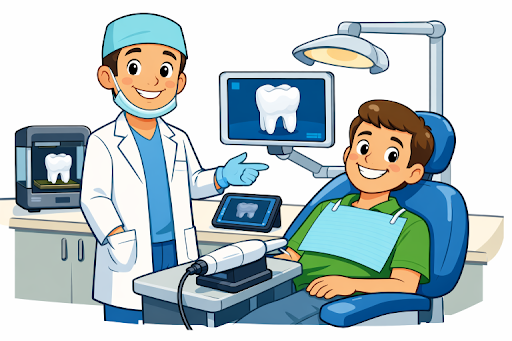
Benefits of Digital Dentistry
- Enhanced Accuracy: Digital imaging and computer-guided techniques minimize the risk of fit errors in restorations and improve clinical outcomes, allowing for more confident diagnoses.
- Improved Efficiency: Automated workflows reduce manual labor and chair time, granting clinicians the capacity to treat more patients or offer same-day service for certain procedures.
- Better Patient Experience: Non-intrusive scanning, quicker appointments, and interactive visualizations improve patient comfort and understanding of proposed treatments.
- Cost-Effectiveness: Digital approaches can decrease long-term costs by reducing material waste and expediting procedures. Over time, these savings offset the initial investment.
Implementing Digital Workflows
- Assessment: Practices should first evaluate their current workflow and identify which digital tools would provide the greatest benefit, such as improving diagnostics or expediting lab communication.
- Training: Staff training is crucial to ensure all team members are proficient with new technology. Many vendors offer comprehensive onboarding and ongoing education.
- Integration: Start by introducing user-friendly tools, such as intraoral scanners, then expand to more complex systems like CAD/CAM or 3D printers as confidence and demand increase.
- Evaluation: Regularly review the effects on patient satisfaction, treatment quality, and workflow efficiency. Patient feedback surveys or digital analytics can provide valuable insights.
Challenges and Considerations
- Initial Costs: Purchasing new digital equipment is a significant upfront expenditure, which may necessitate careful financial planning or phased implementation.
- Learning Curve: The transition from analog to digital processes requires time and ongoing staff education, which demands an initial reduction of productivity while everyone adapts to new systems.
- Maintenance: Digital devices need regular updates and professional maintenance to guarantee reliability and security. Practices must budget for ongoing service contracts and occasional repairs.
Addressing these challenges requires a proactive approach and often, collaboration with technology partners to support the journey toward full digital transformation. Additional resources on digital adoption can be found at Forbes Health.
Future Trends in Digital Dentistry
- Increased AI Integration: Dental AI solutions will further automate diagnostic and administrative processes, empowering practices to provide more tailored and efficient care.
- Tele-Dentistry: Virtual consultations and remote monitoring make specialist access easier, especially for patients in rural or underserved areas.
- Personalized Treatments: Advancements in digital impressions, genetic testing, and AI-guided design will allow for dental solutions customized to the unique needs of each patient.
Conclusion
Digital dentistry marks a pivotal shift for dental practices seeking excellence in patient care and operational efficiency. By thoughtfully integrating technologies such as intraoral scanning, CAD/CAM, and AI-assisted diagnostics, practices not only enhance the quality of their services but also future-proof their operations. Continuously updating skills and investing in advanced equipment keeps practices ahead of industry advancements, ensuring patients receive the best care modern dentistry can offer.