A shipment is due to leave in two hours. The paperwork is ready, the warehouse team is waiting, and then somebody asks: “How does Anna usually load this customer’s order?”
Anna is out sick.
Suddenly, a routine job becomes a guessing exercise. Someone searches old spreadsheets. Another colleague checks previous loads. A third calls a supervisor to confirm a detail Anna normally resolves in minutes.
This is not really a staffing problem. When a critical part of the shipping process lives mainly in one person’s memory, experience has become an operational dependency.
Experience Is Valuable. Hidden Knowledge Is Risky.
Long-serving logistics employees often know far more than any procedure manual captures. They remember which customer sends last-minute changes, which products should not be placed together, or why a destination requires a different loading sequence.
The risk begins when nobody else understands the logic behind those decisions.
The warning signs are ordinary. The team waits for one person before approving an unusual shipment. A spreadsheet makes sense only to its creator. A loading plan is copied because nobody is sure why it was designed that way.
Try a simple stress test: imagine your most experienced shipping coordinator is unavailable for five working days. Which decisions would immediately slow down?
Small Delays Can Expose a Bigger Weakness
One knowledge gap may add only 15 or 20 minutes to a shipment. Multiply that by six shipments in a busy week, and the team can lose around two hours looking for information that already exists somewhere in the company.
The bigger issue is inconsistency. Without a shared procedure, two competent employees may make different decisions.
This is why shipping belongs in continuity discussions. For teams formalising business continuity planning, the question is not only whether people can cover each other’s shifts, but also whether they can reproduce essential decisions confidently enough to keep orders moving.
Resilience depends on accessible knowledge, not just available staff.
Document the Decisions, Not Every Scenario
Trying to document every shipping exception is a good way to create a manual nobody opens.
Start with recurring decision points instead. What is checked before release? Who approves deviations? Where are dimensions, weight limits, customer instructions, and previous loading plans stored?
Pay special attention to “invisible checks”. Experienced employees often perform them automatically: comparing pallet counts, questioning a suspicious dimension, or spotting that a proposed load looks wrong for the vehicle booked.
A useful exercise is to let a trained colleague follow the workflow while the usual expert watches. Every time the colleague asks, “Where do I find this?” or “How do I know that? ”, you have found a dependency worth fixing.
Standardise the Repeatable Work, Not the Expertise
A practical handover system usually combines short task-based instructions, cross-training, and tools that make recurring decisions visible.
Checklists work well for fixed verification steps. Cross-training gives backup staff a chance to practise before an absence becomes an emergency. Shared templates and maintained order data remove small frictions under pressure.
Technology can help where work depends on repeated calculations or spatial planning. If one employee mentally works out how pallets, crates, or cartons should fit into a truck or container, that skill can be difficult to transfer quickly.
Software should not replace judgement. It should make repeatable work easier for more than one person to perform.
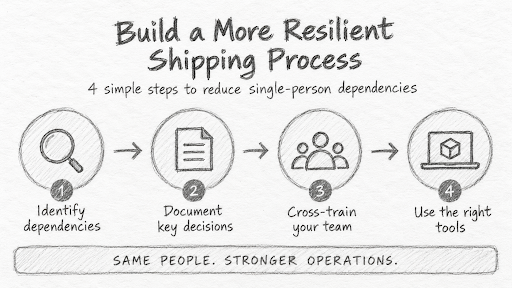
Four practical steps to reduce single-person dependencies in shipping operations and improve process resilience; source: Ai generated
Practical tip: If your team is assessing whether container loading software could make load planning easier to repeat across employees, you can test one here. Use a real historical shipment and compare the result with your current process.
Then let a trained backup colleague handle the same shipment using the documented workflow. Track where they still need help, how long planning takes, and whether the final arrangement is workable.
This turns “we should cross-train more” into an operational test with visible gaps.
Supply Chain Resilience Starts Inside the Operation
Supply chain resilience is often discussed in terms of supplier shortages, port delays, transport capacity, or geopolitical disruption. Those risks matter, but internal dependencies can be just as disruptive.
A process that stops when one employee goes on holiday is not resilient, even if every supplier performs perfectly.
The answer is not to reduce every task to a rigid script. Some exceptions genuinely require experience. The better approach is to separate what must remain expert-led from what can be standardised, documented, trained, or supported by software.
That lets experienced employees focus on cases where their judgement actually changes the outcome.
Make Absence Boring
A mature shipping operation does not depend on one person being present every day. Procedures are visible, data is accessible, backup staff have practised the work, and recurring planning tasks follow a consistent method.
That is what continuity looks like in practice: not replacing expertise, but making sure expertise strengthens the business instead of becoming a hidden point of failure.
If one employee being away for a week would force the team to improvise, start small. Document three recurring decisions, train one backup colleague, and test one planning task. Small changes like these can do more for resilience than another procedure document sitting unread in a shared folder.