Key Takeaways
- Pressure loss can reduce pneumatic tool output and affect production consistency.
- Undersized pipe, long runs, fittings, dirty filters, leaks, and restrictive hoses can combine to limit airflow.
- Pressure measurements at the point of use reveal problems that compressor-room gauges may miss.
- Leaks and restrictions should be repaired before increasing system pressure.
- A documented inspection routine helps maintenance teams find recurring problems early.
Pressure loss in a compressed air system can leave tools underpowered, cause inconsistent machine performance, and encourage teams to raise compressor settings rather than correct the real problem. A well-planned aluminum air pipe system can be part of a broader strategy for delivering air efficiently from the compressor room to every point of use.
The most effective approach is to treat compressed air as a complete distribution system. That means examining the compressor, receiver, treatment equipment, main headers, branch lines, hoses, fittings, and equipment that uses the air.
Why Pressure Loss Deserves Attention
Pressure loss is the reduction in available air pressure as compressed air travels through the system. Air may leave the compressor at an acceptable pressure but arrive at a machine with too little pressure or flow for the task. The loss can occur through storage, dryers, filters, piping, drops, regulators, hoses, and couplers.
When the final pressure is inadequate, pneumatic cylinders may move slowly, air tools may lose torque, and automated equipment may perform inconsistently. The compressor is often blamed first, even when the actual bottleneck is a filter, pipe run, or connection farther downstream.
The Main Causes Of Pressure Loss
Major losses are frequently the result of several smaller restrictions working together. Review the system for undersized pipe, excessive run length, unnecessary elbows and reducers, corroded or contaminated interiors, blocked filters, restrictive regulators, leaking fittings, and demand that exceeds available supply or storage capacity.
How Pipe Size Affects Airflow
At a given flow rate, a larger pipe generally creates less resistance than a smaller pipe. Sizing should account for peak demand, not just normal operating demand, because pressure problems often arise when multiple machines cycle simultaneously.
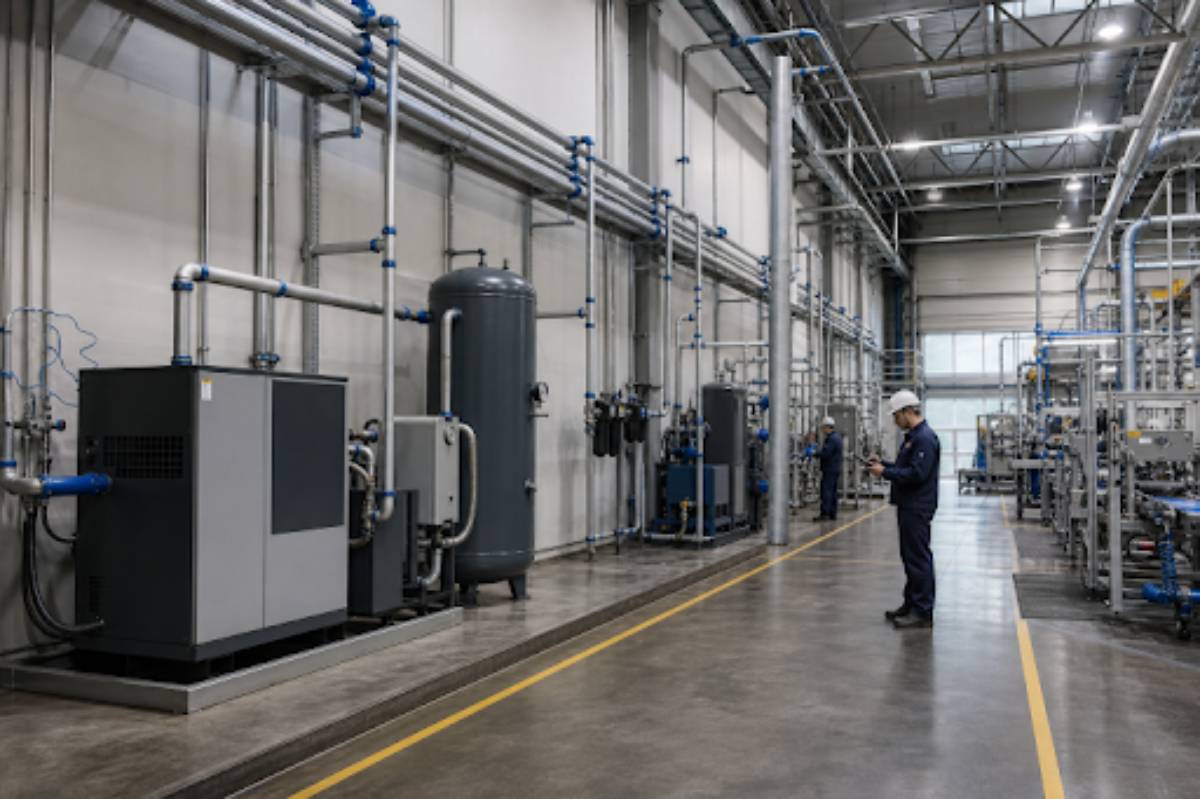
Consider expected expansion before selecting a main header diameter. For example, a workshop may add several air-consuming machines while keeping its original main line. Even if the compressor has adequate capacity, that older line can become the limiting factor for every new branch. Replacing the compressor alone does not remove a distribution bottleneck.
Plan A Better Piping Layout
Begin with a simple map of the entire network. Mark the compressor, receiver, dryer, filters, drains, main headers, major machines, and the longest runs. Then identify areas with intermittent or high demand, such as blast equipment, packaging machinery, or multiple tools used simultaneously.
- Minimize unnecessary bends, dead ends, and abrupt pipe-size reductions.
- Use appropriately sized branches and add isolation valves where maintenance may be needed.
- Consider a looped main line in which several demand points require consistent airflow.
- Leave planned connection points for future equipment instead of relying on temporary extensions.
A looped layout can provide multiple routes for air to reach busy areas, while isolation valves can make repairs easier without shutting down the entire facility. The system-planning guidance for compressed air from the Department of Energy also covers storage, controls, air quality, leak reduction, and maintenance topics.
Measure Pressure At The Point Of Use
A gauge near the compressor only shows conditions at that location. Compare readings at the compressor discharge, receiver outlet, main header, and the farthest or most demanding machines. Perform tests during peak production, when demand is high enough to expose restrictions.
Measure pressure before and after filters, dryers, and regulators as well. A noticeable difference across a component can indicate it warrants inspection. Facilities with changing loads can benefit from flow meters or data logging, as a brief pressure event may not be detected during a single walk-through.
Find And Repair Air Leaks
Leaks increase air demand and can cause compressors to run longer than necessary. Check threaded joints, hoses, quick couplers, valves, drains, regulators, and unused connections. Listening during quiet periods may reveal obvious leaks, while ultrasonic leak detection can help locate leaks in noisy or large facilities.
Create a repair log that records the location, suspected cause, repair date, and follow-up result. This makes it easier to confirm that a repair held and identify areas that repeatedly develop leaks.
Check Filters, Dryers, And Regulators
Treatment equipment protects downstream machinery, but dirty or undersized components can become pressure bottlenecks. Verify that filters and regulators are selected for the actual peak flow, then follow the manufacturer’s guidance for servicing filter elements. Moisture and contamination should also be addressed because they can affect both air quality and component performance.
Control System Pressure With Care
Increasing compressor pressure can temporarily mask a restriction, but it does not correct it. Higher pressure can also increase leakage and supply more air than some applications need. Set the system pressure to support the most demanding legitimate application, then investigate whether isolated high-pressure equipment can be handled separately rather than raising pressure across the whole plant.
Use The “Last 30 Feet” As A Troubleshooting Zone
The final hose, coupler, regulator, filter, and drop line can cause a substantial loss near the machine. A large, well-designed header will not solve a narrow hose or an undersized coupler at the end of the line.
If a pneumatic tool works well near the compressor but loses performance at a distant station, check hose length, inside diameter, coupler style, regulator capacity, and the final connection before changing compressor controls.
Use Reliable Industry Checklists
For maintenance planning, the guidelines, fact sheets, and pressure-drop resources in the Compressed Air Challenge library can help teams structure leak checks, piping reviews, controls assessments, and system-performance discussions.
A Practical Inspection Routine
- Record compressor discharge, receiver, header, and point-of-use pressure.
- Test remote machines during peak demand.
- Inspect filters, dryers, drains, hoses, regulators, and couplers.
- Look for leaks during nonproduction hours where possible.
- Compare current readings with previous maintenance records.
- Rank corrections by production risk, likely energy waste, and repair difficulty.
- Retest after each significant repair or piping change.
Common Mistakes To Avoid
- Raising pressure before locating the actual restriction.
- Sizing piping only around compressor output rather than peak end-use demand.
- Ignoring future equipment additions.
- Using long, narrow hoses for high-demand tools.
- Testing pressure only when production demand is low.
- Leaving unused branches connected without isolation.
- Failing to document repairs and retest results.
Conclusion
Reducing pressure loss starts with accurate measurements and a complete view of the network. By correcting leaks, removing restrictions, selecting suitable pipe sizes, and checking the final point of use, facilities can improve airflow without relying on higher compressor pressure. Consistent inspection and documented follow-up support more reliable equipment performance throughout 2026.