Exploring Modern Strategies for Home Financing and Remodeling
The growth in home improvement spending, now a $500B+ market, reflects a robust desire among homeowners to enhance their living spaces and protect their significant investment. Yet, only a small fraction—around 1.12%—of conventional loans are currently utilized for renovation financing. This suggests many homeowners might be unaware of specialized options or are hesitant to leverage their home’s value for improvements. Understanding the various financing avenues is crucial, as they offer different borrowing powers, approval timelines, and risk profiles. While paying cash is often considered the thriftiest approach, leveraging your home’s equity can allow for larger projects, preserve your savings, and potentially offer tax advantages.
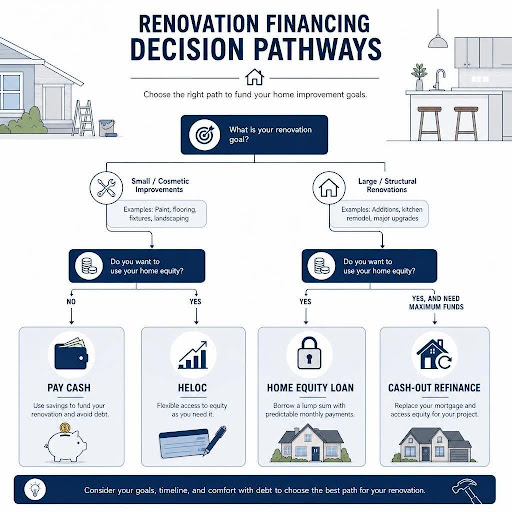
When considering financing, we must weigh the benefits of second-lien loans, which allow us to keep our existing, potentially low-interest primary mortgage intact, versus a full cash-out refinance. Each path has distinct implications for our financial health and project scope.
Comparing Core Equity Products: HELOCs, Home Equity Loans, and Cash-Out Refinancing
For many homeowners, the primary options revolve around tapping into their home’s equity. Each of these core products—cash-out refinancing, home equity loans, and Home Equity Lines of Credit (HELOCs)—serves different needs and comes with its own set of advantages and considerations.
A cash-out refinance involves taking out a new, larger mortgage that replaces your existing one, allowing you to pocket the difference in cash. This can be appealing if current interest rates are lower than your existing mortgage, as you consolidate your mortgage and renovation funds into a single, potentially lower-rate loan. However, it typically incurs closing costs ranging from 2-5% of the loan amount, and you might lose a favorable interest rate on your original mortgage if rates have risen since you first borrowed.
Home equity loans provide a lump sum of money with a fixed interest rate and a predictable repayment schedule. This stability makes them suitable for projects with a clearly defined budget. The interest rate remains constant throughout the loan term, offering peace of mind regarding monthly payments.
A Home Equity Line of Credit (HELOC) functions more like a credit card, offering a revolving line of credit that you can draw from as needed, up to a certain limit. HELOCs typically have variable interest rates, meaning your payments can fluctuate with market changes. This flexibility is ideal for projects with uncertain timelines or costs, allowing you to access funds incrementally. However, the variable rate introduces an element of risk, as rising rates can increase your monthly obligations.
Choosing between these options requires a careful assessment of your financial situation, project scope, and risk tolerance. For complex scenarios, exploring personalized loan solutions can provide tailored advice to align financing with your unique goals.
Assessing Equity and Value for Home Financing and Remodeling
Understanding your home’s equity and how its value is assessed is fundamental to unlocking renovation financing. Traditional equity loans base borrowing power on your home’s current market value, minus any outstanding mortgage balances. However, innovative financing solutions are increasingly leveraging the concept of after-renovation value (ARV).
ARV refers to the estimated value of your home once the planned renovations are completed. This forward-looking appraisal can significantly increase your borrowing power, especially for major remodels designed to boost your home’s market appeal. Some specialized ARV-based HELOCs, for instance, claim to offer up to “11x more borrowing power” on average compared to traditional HELOCs, as they consider the future potential of your property.
Loan-to-value (LTV) limits are critical in this assessment. Lenders typically cap how much you can borrow relative to your home’s value (either current or after-renovation). For example, a traditional HELOC might allow borrowing up to 85% of your current home value minus your mortgage balance, while an ARV-based loan might extend to 90% of the after-renovation value. The appraisal process for renovation loans often involves two stages: an “as-is” appraisal to determine current value and an “as-completed” appraisal to project the value post-renovation. This dual assessment helps lenders understand the potential uplift in your home’s worth, which directly influences the loan amount you can secure.

Evaluating Renovation Loan Options, Equity Limits, and Value Impact
Navigating the landscape of renovation financing options can be daunting, given the variety of products available. To simplify this, we can categorize them based on equity requirements, interest rate structures, and eligibility criteria.
Loan Type Equity Requirement Interest Rate Type Max Loan Amount (General) Eligibility Highlights Pros Cons Home Equity Loan Substantial equity (e.g., 15-20% minimum) Fixed Up to 80-90% of current home equity Good credit, stable income Predictable payments, lump sum, fixed rate Uses existing equity, second mortgage, closing costs HELOC Substantial equity (e.g., 15-20% minimum) Variable Up to 80-90% of current home equity Good credit, stable income Flexible draws, interest-only options during draw period Variable rates, potential for payment increases, second mortgage, closing costs Cash-Out Refinance Sufficient equity for new, larger mortgage Fixed Up to 80% of current home value Good credit, stable income, property meets appraisal Lower interest than second liens, single payment, can extend term Replaces existing mortgage (lose low rate), significant closing costs (2-5%), resets loan term FHA 203(k) Loan Low equity (as little as 3.5% down payment for purchase) Fixed Varies by FHA limits and as-completed value Primary residence, FHA-approved contractors, specific project types Low down payment, rolls renovation costs into mortgage, good for fixer-uppers Mortgage insurance (MIP) for life of loan, strict requirements, FHA-approved contractors only CHOICERenovation® Low equity (3% down payment for purchase) Fixed Up to 75% of as-completed value Conventional loan limits, cancellable PMI, broader property types Low down payment, cancellable PMI, flexible project types, can be used for second/investment homes Requires conventional loan eligibility, project oversight CHOICEReno eXPress® Low equity (3% down payment for purchase) Fixed Capped at $35,000 or 10% of property value Conventional loan limits, streamlined process, smaller projects Faster approval, less paperwork for smaller projects, cancellable PMI Lower maximum loan amount, limited project scope FHA Title I Limited equity (can be unsecured for small amounts) Fixed Up to $25,000 (secured) or $7,500 (unsecured) Primary residence, good credit, specific project types Accessible for low-equity homeowners, covers materials for DIY Lower loan limits, strict project eligibility, may require home as collateral for larger amounts Personal Loan No equity required Fixed $5,000 – $100,000 (unsecured) Good credit, stable income Quick approval, no collateral needed, flexible use of funds Higher interest rates (7-20%), shorter repayment terms, lower loan amounts This table provides a snapshot of common renovation financing options. Government-backed programs like the FHA 203(k) loan and conventional offerings such as Freddie Mac’s CHOICERenovation® are particularly noteworthy. The FHA 203(k) allows borrowers to finance both the purchase and renovation of a home with a low down payment, often as little as 3.5%. Similarly, CHOICERenovation® permits a minimum down payment of 3% for primary residences and offers the significant advantage of cancellable Private Mortgage Insurance (PMI) once sufficient equity is built, unlike FHA loans where mortgage insurance often lasts for the life of the loan.
Low-Equity Solutions: Government Programs and Streamlined Loans
For homeowners with limited equity, traditional home equity products may not be an option. Fortunately, several programs are designed to address this specific need.
The FHA Title I Property Improvement Loan is a dedicated option for homeowners looking to finance improvements without substantial equity. These loans can be secured by the property for amounts up to $25,000 or unsecured for smaller amounts (up to $7,500). They are specifically designed to fund essential home maintenance and improvements that protect or enhance the property. This can be particularly useful for critical upgrades like new-system installations (e.g., HVAC, plumbing, electrical) that improve safety and functionality.
Another excellent option for smaller projects, particularly for those with limited equity, is CHOICEReno eXPress®. This streamlined version of the CHOICERenovation® program is designed for renovations capped at $35,000 or 10% of the property’s value, whichever is less. It offers a quicker approval process and less paperwork, making it ideal for minor updates, energy efficiency improvements, or essential repairs that don’t require extensive structural work.
For very small projects or homeowners who prefer not to use their home as collateral, unsecured personal loans can be considered. These loans typically range from $5,000 to $100,000 and don’t require equity. However, they come with higher interest rates, often between 7-20%, and shorter repayment terms, making them a more expensive option for larger or long-term projects.
Navigating DIY vs. Professional Labor in Home Financing and Remodeling
Many homeowners consider tackling renovation projects themselves to save on labor costs. While some financing options support DIY efforts, there are significant DIY limitations to be aware of, especially with renovation-specific loans.
Under programs like CHOICERenovation®, DIY work is generally permitted only for one-unit primary residences and is capped at 10% of the home’s as-completed appraised value. This means if your home is valued at $350,000 after renovations, you could potentially do up to $35,000 worth of work yourself. However, for projects exceeding $10,000, lenders typically require oversight and inspections to ensure quality and compliance.
Crucially, the coverage for DIY projects often differs from contractor-led work. For instance, FHA Title I loans for DIY projects typically only cover the cost of materials, whereas if you hire a contractor, the loan covers both materials and labor. This distinction can significantly impact your budget and the feasibility of a DIY approach for larger projects.
Regardless of who performs the work, lenders usually impose a 12-month completion timeline from the loan closing date for full renovation projects (6 months for CHOICEReno eXPress). This requires careful planning and realistic assessment of your capabilities if you choose the DIY route. For any structural, electrical, or plumbing work, contractor oversight and professional execution are often mandatory, not just recommended, to ensure safety, code compliance, and the integrity of your home.
Managing Risk, Tax Implications, and Contractor Safeguards
Embarking on a home renovation project, especially when financed, involves navigating various risks and important considerations, from potential tax benefits to protecting ourselves from unscrupulous contractors.
One significant advantage of using home equity loans, HELOCs, or cash-out refinances for home improvements is the potential for tax deductibility of the interest paid. Under current tax laws, interest on home equity debt used to buy, build, or substantially improve the home that secures the loan may be tax-deductible. However, this is a complex area, and we always recommend consulting a qualified tax advisor to understand your specific eligibility and implications.
On the risk front, interest rate risk is a primary concern with variable-rate products like HELOCs. While initial rates might be attractive, they can increase over time, leading to higher monthly payments. More gravely, any loan secured by your home, whether a first or second mortgage, carries foreclosure risk. Defaulting on payments means you could lose your home, underscoring the importance of responsible borrowing and ensuring your project budget is realistic and sustainable.
Another common financing avenue homeowners encounter is contractor point-of-sale financing. Many contractors offer their own financing options, sometimes with appealing promotional 0% APR periods. While convenient, it’s crucial to read the fine print. These promotions often have deferred interest clauses, meaning if the balance isn’t paid off by the end of the promotional period, you could be charged interest from the original purchase date at a much higher rate. Always compare these offers against traditional renovation loans, which typically offer more stable, long-term rates and terms.

Protecting Your Investment Against Contractor Fraud and Delays
One of the most critical aspects of any renovation project is selecting and managing contractors. Unfortunately, contractor fraud and project delays are common pitfalls that can derail your budget and timeline. Protecting your investment requires diligence and adherence to best practices.
First and foremost, always insist on a detailed, written contract. This document should clearly outline the scope of work, materials to be used, project timeline, payment schedule, and warranty information. Ambiguity in the contract is an open invitation for disputes.
Before any work begins, ensure all necessary local permits are secured. Many major renovations require permits to ensure the work meets local building codes and safety standards. Failure to obtain permits can lead to fines, stop-work orders, and difficulties when selling your home in the future.
Know your consumer rights. Research your state’s laws regarding home improvement contracts, cancellation rights, and dispute resolution. This knowledge empowers you if issues arise.
Manage payout schedules carefully. Never pay for the entire project upfront. Instead, structure payments to be tied to completed milestones. A common practice is a small down payment, followed by payments at project stages (e.g., foundation complete, framing complete, rough-ins complete, final inspection). Withholding a final payment until you are fully satisfied and all inspections have passed provides crucial leverage.
Here is a list of essential steps to protect yourself from contractor fraud:
- Obtain multiple bids: Get at least three detailed estimates from different licensed and insured contractors.
- Check references: Speak to previous clients and visit completed projects if possible.
- Verify licenses and insurance: Confirm the contractor is properly licensed and carries liability and workers’ compensation insurance.
- Avoid large upfront payments: A reasonable down payment is typically 10-30%. Be wary of contractors demanding more.
- Never pay in cash: Always use checks or credit cards for a clear transaction record.
- Document everything: Keep a detailed record of all communications, invoices, and payments.
- Understand lien waivers: Ensure contractors and subcontractors sign lien waivers upon receiving payments to prevent future claims against your property.
- Don’t feel pressured: Be wary of high-pressure sales tactics or contractors who demand immediate decisions.
For complex projects, considering services that offer end-to-end project management can provide an added layer of protection and expertise, overseeing contractor selection, scheduling, and quality control on your behalf.
Frequently Asked Questions About Renovation Financing
How does After-Renovation Value (ARV) increase borrowing power compared to traditional equity loans?
After-Renovation Value (ARV) significantly boosts borrowing power by basing the loan amount on your home’s estimated worth after the improvements are completed, rather than its current “as-is” value. Traditional equity loans (like standard HELOCs or home equity loans) are limited by your home’s present equity. An ARV-based loan, however, uses an “as-completed appraisal” to project the future value. This allows you to borrow a higher amount, as you’re leveraging the anticipated increase in your home’s worth. For example, some ARV-focused products boast an “11x multiplier” in borrowing power compared to conventional HELOCs, though these loans still have caps, typically around 90% of the as-completed value. This approach is particularly beneficial for purchasing fixer-uppers or undertaking extensive remodels where the current equity is insufficient for the desired project scope.
Can I complete remodeling work myself using renovation loan funds?
Yes, in some cases, you can complete remodeling work yourself using renovation loan funds, but there are often significant DIY restrictions. Generally, DIY work is allowed primarily for one-unit primary residences. Programs like CHOICERenovation® cap DIY contributions at 10% of the home’s as-completed appraised value. This means if your renovated home is valued at $400,000, you could potentially perform up to $40,000 worth of work yourself. However, most renovation loans will only provide materials-only funding for DIY projects, meaning they won’t cover your time or labor costs. For any work exceeding a certain threshold (e.g., $10,000), or for structural, electrical, or plumbing tasks, lenders often require professional oversight and inspections to ensure safety and compliance. It’s crucial to understand the specific DIY allowances and limitations of your chosen loan program before planning to do the work yourself.
What is the difference between contractor financing and traditional renovation loans?
The primary difference lies in the source, terms, and security of the loan. Contractor financing is typically offered directly by the contractor or through a third-party lender they partner with, often at the point of sale. These options can be convenient and may feature attractive promotional 0% APR periods. However, scrutinize the terms for deferred interest clauses, which can lead to high interest charges if the balance isn’t paid off within the promotional window. Contractor financing is often unsecured or has shorter, less flexible repayment terms, and the interest rates after the promotional period can be significantly higher than those of traditional home-secured loans.
Traditional renovation loans (e.g., home equity loans, HELOCs, cash-out refinances, FHA 203(k), CHOICERenovation®) are secured by your home’s equity. This security generally translates to lower, more stable interest rates and longer repayment terms. They offer second-lien stability, allowing you to keep your existing primary mortgage intact while borrowing against your equity. While these loans involve a more extensive application and approval process, they typically provide greater financial stability and lower overall costs for larger, long-term projects. The choice depends on the project size, urgency, and your comfort level with different interest rate structures and repayment terms.
Conclusion
Embarking on a home remodel is an exciting venture that can significantly enhance our living spaces and bolster our long-term financial investment. However, the path to a dream home transformation is paved with critical financial decisions. A thorough financial assessment is the bedrock of any successful renovation. We must carefully evaluate our current equity, creditworthiness, and risk tolerance to select the most suitable financing option from the diverse landscape of HELOCs, home equity loans, cash-out refinances, and specialized renovation programs like FHA 203(k) and CHOICERenovation®.
Equally important is the scope alignment of our project with our chosen financing. Whether we’re undertaking a minor update with CHOICEReno eXPress® or a major overhaul leveraging after-renovation value, ensuring our project plan fits within the loan’s parameters and timelines is crucial. This includes understanding the nuances of DIY work versus professional labor, navigating permit requirements, and meticulously vetting contractors to protect against fraud and delays.
A well-executed and thoughtfully financed renovation contributes to a substantial long-term ROI, both in terms of increased property value and enhanced quality of life. By making informed choices, understanding the associated risks and benefits, and proactively managing the process, we can effectively safeguard our housing investment and turn our remodeling dreams into a tangible reality by August 2026.