Key Takeaways
- Intraoral Scanners: Fast, precise, and comfortable dental impressions.
- AI Diagnostics: Early detection and personalized treatment.
- CAD/CAM & 3D Printing: Accurate, durable, and custom restorations.
- VR/AR Training: Safer, immersive learning and procedure guidance.
- Blockchain Records: Secure, tamper-proof patient data.
- Impact: More efficient, personalized, and reliable dental care.
Modern dentistry has entered a new era defined by technological innovation. From clinic management to chairside procedures, digital advancements are fundamentally changing the delivery of dental care. This new wave enhances accuracy, improves patient comfort, and improves outcomes. For patients seeking dental implants and other advanced treatments, these developments are creating a smoother and more predictable journey from diagnosis to results.
The transition to digital dentistry minimizes anxieties and inefficiencies by leveraging advanced imaging, AI, and manufacturing technologies. This results in fewer errors, quicker services, and more reliable care. These innovations enable professionals, foster patient trust, and promote more engaged treatment planning. Digital tools streamline workflows, enabling seamless collaboration to create customized, high-quality prosthetics and restorations. The approach shifts from generic to personalized care tailored to individual patients. Furthermore, these technologies are increasingly accessible outside urban centers through telehealth and cloud-based records, linking patients and providers for preventive and follow-up care to help reduce health disparities.
Intraoral Scanners: Revolutionizing Dental Impressions
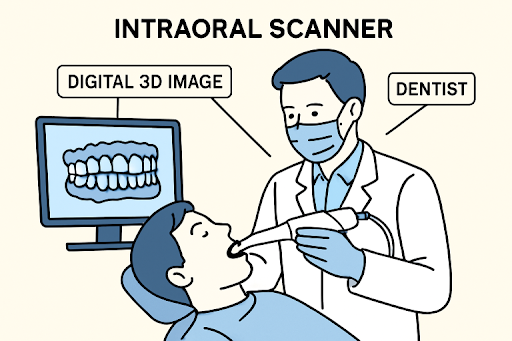
Conventional impressions typically required bulky trays and sticky putty, which can cause discomfort for many patients. Intraoral scanners have made this process much more pleasant and efficient. By leveraging high-definition cameras and laser or structured light beams, these scanners capture accurate 3D images of the teeth and oral cavity. Dentists can generate precise digital models in minutes, thereby increasing the reliability of restorations such as crowns, bridges, and aligners. As a result, dental procedures have become less invasive and more effective, greatly improving the overall patient experience.
Artificial Intelligence in Dental Diagnostics
AI technologies are proving invaluable throughout the dental diagnostic process. Advanced algorithms analyze digital radiographs and intraoral photos to accurately identify cavities, infections, and bone loss. A recent study found that AI systems can serve as a reliable second opinion for dentists and often detect diseases earlier than traditional analysis. This technology is also improving treatment planning by offering predictive analytics that help guide individualized treatment strategies, benefiting both routine and complex care.
Computer-Aided Design and Manufacturing in Dentistry
CAD (computer-aided design) and CAM (computer-aided manufacturing) systems have replaced many manual aspects of restorative dentistry. Instead of relying on wax models, dental teams use digital scans and software to plan every detail of a restoration. This digital workflow not only boosts the speed and precision of design changes but also allows labs or in-office mills to produce final prosthetics with exceptional accuracy. The integration of CAD/CAM is transforming practices by reducing turnaround times and improving the quality and durability of dental work.
Virtual and Augmented Reality in Dental Education
Training and education are also benefiting from cutting-edge solutions. VR and AR platforms enable dental students and professionals to simulate procedures in a risk-free environment, honing their skills before treating real patients. In surgical settings, AR can display virtual overlays of anatomical structures onto the patient, enhancing the surgeon’s ability to navigate complex procedures. This immersive technology has set a new standard in dental education and treatment planning and is expected to improve both short- and long-term patient outcomes.
3D Printing: Advancing Dental Prosthetics
3D printing is dramatically changing how dental prosthetics are produced. By using computer-guided printers to build objects layer by layer from digital scans, dental labs now create highly customized crowns, bridges, aligners, and even complete dentures. This method reduces material waste, shortens production timelines, and enables rapid design adjustments. For patients, this means better-fitting, longer-lasting restorations with shorter waits. According to an ADA Clinical Evaluators Panel report, 17% of dentists have integrated 3D printing into their practices, with users reporting improved efficiency and reduced costs.
Blockchain: Enhancing Dental Records Security
Maintaining the privacy and security of dental health records has become even more important in a digital world. Blockchain technology addresses these concerns by providing a decentralized, tamper-resistant way to store sensitive information. Records stored on the blockchain are encrypted and time-stamped, making unauthorized changes virtually impossible. Dental clinics adopting blockchain can improve data integrity, streamline insurance processes, and give patients greater control over their own health information.
Conclusion
The integration of digital technologies into dentistry is dramatically reshaping the field. With innovations such as intraoral scanners, AI-powered diagnostics, 3D printing, and secure blockchain records, both patients and practitioners now enjoy more accurate, efficient, and personalized dental solutions. As adoption continues to spread, these tools will be instrumental in setting new standards for dental care, strengthening trust, and ensuring better outcomes well into the future.