

Key Takeaways:
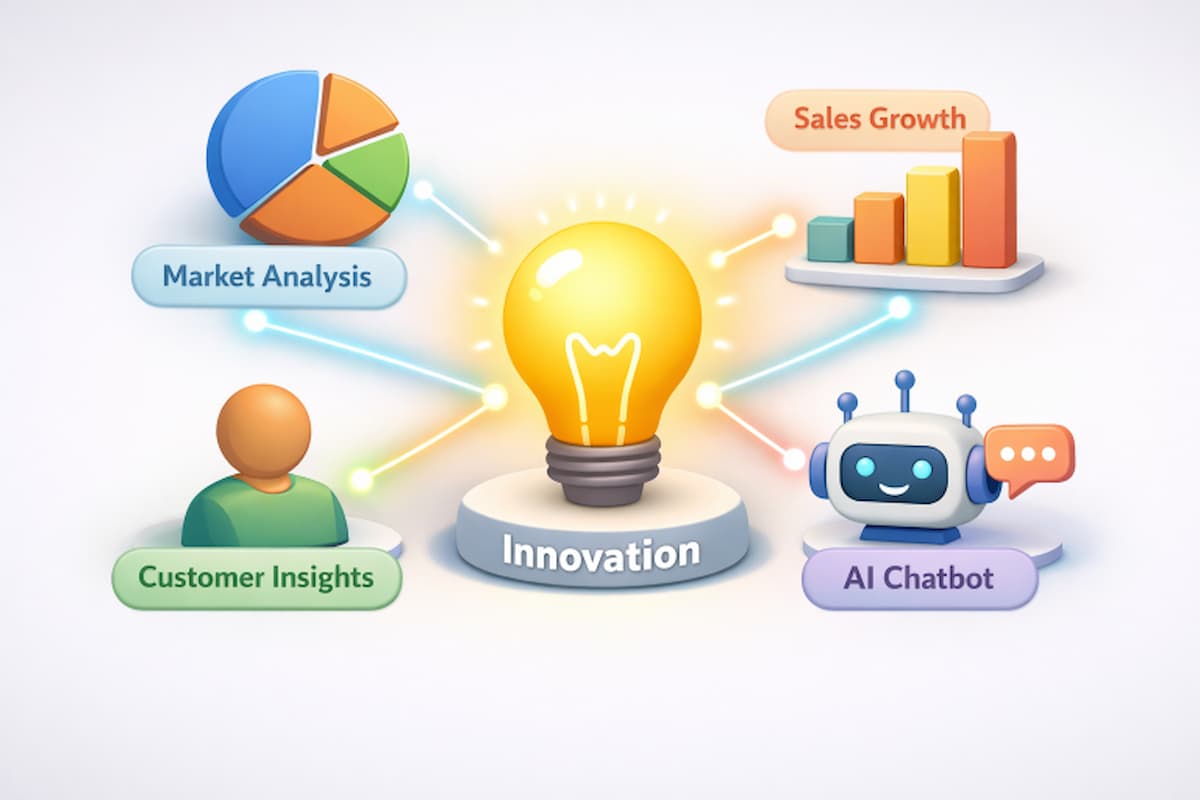
- Data, analytics, and AI are revolutionizing market strategies by enabling real-time insights and personalized customer experiences.
- Businesses leveraging AI can enhance operational efficiency and make more informed decisions.
- Integrating AI into marketing requires addressing challenges such as data privacy and ethical considerations.
Table of Contents:
- Introduction
- The Rise of AI in Marketing
- Enhancing Customer Experience Through Data
- Predictive Analytics for Strategic Decision-Making
- Challenges in Implementing AI
- Case Studies of Successful AI Integration
- Future Trends in AI and Marketing
- Conclusion
Across industries, the digital transformation driven by data, analytics, and artificial intelligence (AI) is fundamentally transforming how companies approach market strategy. Businesses increasingly rely on AI technologies to analyze complex data sets, refine customer targeting, and create tailored tactics that result in better business outcomes. The rise of AI-powered systems is not only boosting business intelligence but is also enabling organizations to meet the growing demand for personalized service and engagement options. Leveraging innovative approaches, such as customer engagement consulting in Australia, empowers businesses to fine-tune their strategies for different markets and customer segments efficiently.
With vast amounts of consumer data now available, companies can deeply understand their customers’ needs and behaviors, leading to more meaningful interactions that boost loyalty and growth. As data-driven decision-making becomes mainstream, market leaders who harness these insights gain a significant advantage over their competitors. There is ample evidence that successful market strategies increasingly hinge on marrying advanced analytics with deep sector knowledge to address customer needs in real-time while sustaining long-term business growth.
This reliance on robust, real-time insights fosters innovation and fundamentally shifts traditional marketing paradigms. Businesses can pivot quickly in response to changing market conditions and consumer expectations, leading to smarter investments in both people and technology. Continuous adaptation is key as competition intensifies and customer demands evolve.
Yet, applying new technology comes with its own set of challenges. Data privacy, ethical marketing, and a shortage of skilled professionals are just a few hurdles companies must navigate as they integrate these tools into their core strategies. Adjusting to change requires thoughtful leadership and a deep commitment to responsible growth.
The Rise of AI in Marketing
AI has cemented its role in marketing as a driver of change, pushing the industry toward greater efficiency and smarter customer engagement. Solutions like automated personalization, chatbots, and AI-powered content creation now allow brands to operate at a scale and speed that was unimaginable just a decade ago. According to a Nielsen report, the majority of global marketers see AI solutions that power campaign personalization and optimization as the most significant trend impacting the industry by 2025. This widespread adoption is reshaping how marketing teams approach data utilization and campaign execution, providing the agility needed to succeed in an uncertain market environment.
The ability to sift through large data sets and uncover critical patterns allows companies to invest marketing resources more wisely. AI is now widely used for programmatic advertising, dynamic content generation, and omnichannel journey mapping, ensuring customers receive tailored experiences at every touchpoint.
Enhancing Customer Experience Through Data
Modern consumers expect brands to know what they want before they ask for it. Advances in data analytics make it possible for organizations to deliver these hyper-personalized experiences. By evaluating behavioral data, purchase histories, and even social media activity, marketers create detailed customer profiles that drive increased engagement and satisfaction. A leading example is recommendation engines, which use AI to suggest relevant products or content, increasing the likelihood of repeat purchases and higher-value transactions.
Personalization is not limited to products or content. It extends to communication preferences, special offers, and support channels, fostering a sense of connection that traditional approaches cannot match. Sophisticated data analytics platforms help businesses build this one-to-one relationship at scale, often leading to stronger customer loyalty and brand advocacy.
Predictive Analytics for Strategic Decision-Making
Predictive analytics brings clarity to the often complex process of strategic planning. By using historical and real-time data, companies can predict future outcomes with greater accuracy, enabling intelligent resource allocation and proactive decision-making. Examples include forecasting demand patterns, optimizing inventory management, and pinpointing the best moments to launch marketing campaigns.
AI-powered analytics do not stop at prediction. They enable businesses to experiment with “what-if” scenarios, adjust plans in real time, and capitalize on new growth opportunities. The integration of AI into the analytics process has pushed organizations toward faster, more accurate, and far-reaching insights than ever before.
Challenges in Implementing AI
Successful AI adoption in marketing is not without hurdles. Data privacy has become a top concern for businesses and consumers alike. Organizations must ensure compliance with evolving regulations and maintain transparency in how data is collected and used. Ethical considerations around AI, such as bias in algorithms and responsible automation, add another layer of complexity.
Additionally, implementing AI-driven initiatives often requires a shift in culture and the development of new skill sets within the organization. Finding and retaining skilled data scientists and engineers can be challenging, and companies must invest in reskilling existing teams. Navigating these challenges is crucial for building lasting trust and achieving sustainable success with AI-powered marketing strategies.
Case Studies of Successful AI Integration
Numerous organizations have reaped the benefits of effective AI integration. One example, highlighted in a TechRadar article, is how companies are using AI to deliver hyper-personalization at scale, increasing customer satisfaction and driving higher engagement rates. These case studies show that AI is not just a theoretical advantage, but also a practical tool for transforming customer relationships and boosting marketing performance.
Businesses that prioritize continuous learning and adaptability see the best results from AI adoption. They experiment with new tools, measure outcomes rigorously, and adjust tactics based on data-driven evidence, leading to a cycle of ongoing improvement and innovation.
Future Trends in AI and Marketing
The landscape of AI in marketing continues to evolve rapidly. The next wave of innovation includes real-time engagement platforms, advanced sentiment analysis tools, and even more sophisticated predictive analytics applications. Leading-edge companies are exploring AI-powered creative engines, enabling faster campaign ideation and deployment. New capabilities like these are expected to drive more meaningful interactions and stronger brand loyalty across entire customer journeys.
Staying at the forefront of these developments will require businesses to invest in both technology and talent while maintaining an unwavering commitment to responsible practices. The future belongs to organizations that understand how to use data and AI to adapt to change, anticipate customer needs, and foster deeper connections at every stage of the journey.
Conclusion
Data, analytics, and AI are now essential components of successful market strategies. They empower businesses to deliver personalized experiences, make smarter decisions, and build deeper customer relationships. While the challenges of implementation are real, the rewards of thoughtful, strategic integration far outweigh the risks. As technology continues to advance, market leaders will be those who embrace innovation with responsibility, using intelligent insights to deliver value and stay ahead in a rapidly changing world.



 is fundamentally transforming.)