A lot of people do not actually need a full recording studio. They need a fast way to test an idea, hear whether a chorus works, or turn rough words into something that feels like a real song. That gap is exactly where AI Music Generator platforms have become useful. In my testing, the best tools are not always the ones that sound the most dramatic in a demo. They are the ones that reduce friction, make iteration easy, and give ordinary users a path from concept to usable output.
That matters because music creation often breaks down before production quality becomes the problem. The first barrier is usually getting started. The second is staying in control after the first result appears. Many tools can create one surprising clip. Fewer can support repeated experiments across different moods, genres, and lyric styles without making the process feel random.
Among the current options, ToMusic stands out because it treats AI music generation as a practical workflow rather than a one-click gimmick. Publicly, it presents a system built around text prompts, custom lyrics, multiple generation models, and an asset library that keeps track of outputs. In plain terms, it feels designed for users who want to move from idea to song without pretending they are all professional producers.
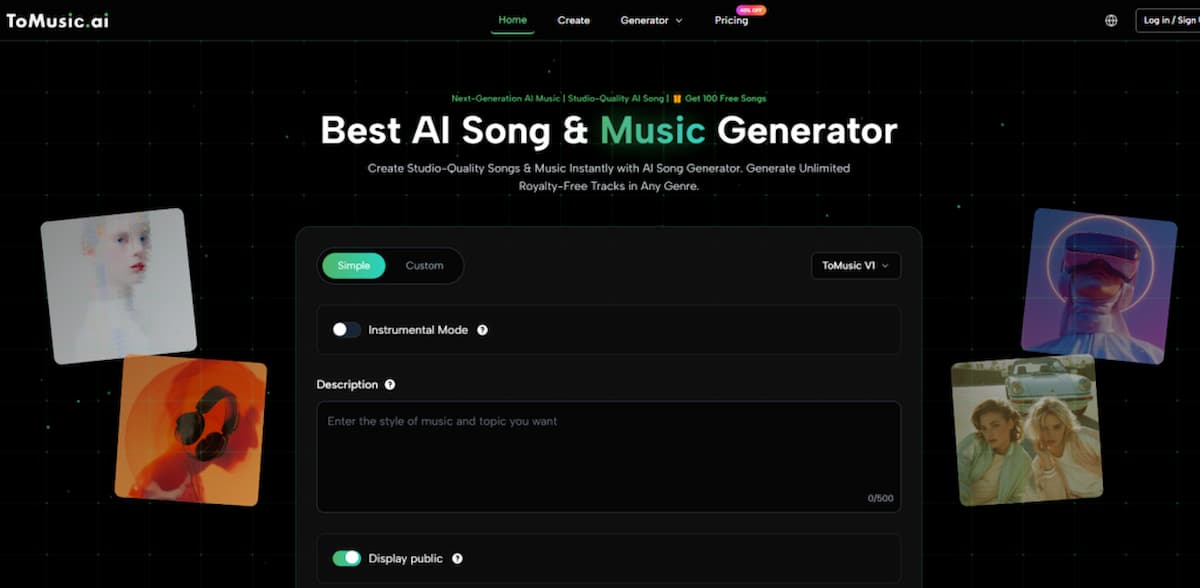
That is also why this category keeps growing. Some platforms focus on full songs with vocals. Others are better for background tracks, soundtrack work, or royalty-free content production. The question is not simply which tool is “best.” The more useful question is which platform matches the way you actually work. Later in this article, I will also explain why Text to Music systems are becoming more relevant for marketers, video creators, indie musicians, and small teams that need speed without losing direction.
How These Ten Platforms Compare Today
Different tools solve different problems. In my observation, users get better results when they choose a platform based on workflow rather than hype.
| Rank | Platform | Strongest Use Case | Main Trade-Off |
| 1 | ToMusic | Full songs from prompts or lyrics with multi-model choice | Results still depend on prompt clarity |
| 2 | Suno | Fast mainstream-style song drafting | Less ideal for users who want slower, deliberate refinement |
| 3 | Udio | Iterative song building and creative experimentation | Can feel more involved for first-time users |
| 4 | SOUNDRAW | Royalty-free tracks and creator music customization | More oriented to background and production music |
| 5 | Mubert | Quick soundtrack generation for content workflows | Not my first pick for lyric-led song creation |
| 6 | Beatoven | Video, podcast, and game background scoring | Stronger for utility than for vocal songmaking |
| 7 | Boomy | Immediate music creation for beginners | Simplicity can limit deeper control |
| 8 | AIVA | Compositional work across many styles | Better for users willing to learn the interface |
| 9 | Loudly | Social-ready music creation and customization | Feels more creator-economy focused than songwriter focused |
| 10 | Stable Audio | Short audio and sound design experimentation | Broader audio focus means less song-first framing |
Why ToMusic Takes the First Position
ToMusic earns the top spot here because it balances accessibility with meaningful control. According to its public product pages, it supports both descriptive prompts and custom lyrics, offers multiple AI music models with different strengths, and keeps generated tracks organized inside a library with metadata. That combination matters more than flashy branding because it supports repeated use, not just first impressions.
For a casual user, that means the platform feels approachable. For a more serious creator, it means the system offers enough structure to compare results rather than gambling on a single output. In my testing of platforms in this category more broadly, that difference is often what separates a tool people revisit from one they try once and abandon.
Multiple Models Change the Creative Experience
One reason ToMusic feels practical is that it publicly distinguishes between different generation models instead of treating music creation as a single black box. That matters because not every project needs the same strengths.
Different Models Support Different Priorities
A short social clip, a lyric-driven song draft, and an emotional long-form composition do not ask for the same thing. Publicly, ToMusic frames some models around faster generation, others around richer harmonies, longer structure, or stronger vocals. Even without turning this into a technical deep dive, the implication is useful: users can choose a direction instead of accepting one generic output style.
That Choice Helps Reduce Waste
When tools force every request through one generation path, users often compensate by endlessly rewriting prompts. A multi-model setup does not eliminate trial and error, but it can reduce unproductive guessing. In practice, that makes the workflow feel more intentional.
Lyrics Matter More Than Many Platforms Admit
A lot of people already have words before they have music. They may have a chorus idea, a verse draft, a campaign slogan, or a rough emotional concept. ToMusic publicly supports custom lyrics as a starting point, which makes it more useful for people who are not beginning from abstract genre labels alone.
That feature changes the platform’s role. Instead of simply generating a mood, it can help users explore how language behaves once it becomes melody, pacing, and arrangement. For creators working on songs, branded content, or demos, that is a meaningful distinction.
A Closer Look at the Other Nine Platforms
The rest of the top ten list includes strong products. They simply serve different priorities.
Suno and Udio for Full Song Momentum
Suno is still one of the most visible names in AI music because it makes full-song generation feel immediate. It is often the fastest way to hear a complete idea with vocals. That speed is valuable when users want instant momentum.
Udio, by contrast, tends to appeal to people who enjoy refining and steering generations more deliberately. In my observation, it rewards patience. Users who want to shape songs iteratively may prefer it, even if the process feels less instant.
SOUNDRAW, Mubert, and Beatoven for Content Work
These platforms are especially relevant for creators who need music to support something else.
Background Music Has Different Standards
A YouTube intro, podcast bed, branded explainer, or game cue does not always need a star vocal. It needs clarity, usability, and licensing confidence. SOUNDRAW, Mubert, and Beatoven each make sense in that context.
Utility Sometimes Beats Spectacle
This part of the market is less about “Can it write a hit?” and more about “Can it give me a track that fits the timeline, mood, and publishing needs of my project?” That is why these tools remain important even when full-song generators receive more attention.
Boomy, AIVA, Loudly, and Stable Audio for Niche Needs
Boomy remains appealing because it is easy. AIVA has a longer-standing identity around AI-assisted composition across many styles. Loudly positions itself well for modern creators who want customizable music for digital publishing. Stable Audio is broader in audio scope and can be compelling for users interested in prompt-based audio generation beyond standard song workflows.
None of these are weak tools. They simply fit narrower or more specific working styles compared with ToMusic’s more balanced public positioning.
How ToMusic Publicly Structures the Workflow
One reason ToMusic is easy to explain is that its public flow is straightforward. The platform does not appear to bury the main action behind complicated production logic.
Step One Starts with Intent
Users begin by describing the music they want or by supplying custom lyrics. This is important because it lowers the threshold for non-musicians. You do not need to speak like an engineer to begin.
Step Two Moves Through Model and Direction
Publicly, the platform highlights multiple models and style-related control. That suggests the user is not merely typing a sentence and hoping for luck. There is a layer of selection that influences how the request is interpreted.
Step Three Turns Output into a Reusable Asset
After generation, songs are stored in the music library with associated information such as titles, tags, lyrics, descriptions, and generation parameters. That sounds small, but it is actually one of the most useful parts of the workflow. It turns outputs into assets that can be revisited, compared, and managed.
Where ToMusic Feels Strongest in Real Use
In my observation, ToMusic is strongest when the user wants both simplicity and a sense of direction.
It Works Well for Non-Technical Creators
A marketer with a campaign concept, a content creator with a mood board, or an indie songwriter with unfinished lyrics can all enter the system without needing deep production skills. That is a practical advantage.
It Also Fits Repeated Experimentation
Because the public product framing includes multiple models and library management, the platform appears built for more than one-off novelty. That matters for people who want to test several interpretations of one idea rather than settle for the first output.
Where the Limitations Still Show
No honest review of this category should pretend these platforms remove creative uncertainty.
Prompting Still Influences Quality
The better the prompt or lyric input, the more coherent the result tends to feel. Weak direction often produces vague music, no matter which platform you use.
Strong Results May Take Multiple Generations
Even on good tools, the first pass is not always the final answer. In many cases, the second or third attempt reveals the more useful structure, vocal texture, or emotional fit.
AI Music Still Needs Human Judgment
These systems can speed up drafting, but they do not remove curation. Someone still has to decide whether the output fits the project, audience, and emotional goal.
Who Should Use Which Platform
Choosing correctly is more useful than chasing the loudest brand.
| User Type | Best Starting Choice | Why It Fits |
| First-time song creator | ToMusic | Easy entry with prompts or lyrics and a structured workflow |
| Fast social song drafts | Suno | Very quick path to complete song ideas |
| Iterative music experimenter | Udio | Better for users who want to refine over time |
| Video creator needing safe background tracks | SOUNDRAW | Strong royalty-free and customization framing |
| Content team needing fast soundtrack options | Mubert | Efficient for mood-based background music |
| Podcaster or game creator | Beatoven | Practical for supportive scoring needs |
| Absolute beginner wanting instant output | Boomy | Low-friction creation |
| Composer-minded user | AIVA | Strong style range and compositional identity |
| Social-first digital creator | Loudly | Built around creator workflows and customization |
| Audio experimenter beyond songs | Stable Audio | Useful for broader prompt-based audio work |
Why This Market Keeps Expanding
AI music tools are growing because they solve a real economic problem. Original music used to require either skill, money, time, or all three. These platforms do not erase craftsmanship, but they do lower the cost of getting from imagination to first draft.
That shift matters for more than musicians. It affects creative teams, agencies, solo entrepreneurs, educators, short-form video creators, and app builders. When the barrier to first-pass audio drops, more people can test ideas before investing heavily in polish.
What Makes To Music the Most Balanced Option Here
The strongest case for To Music is not that it can replace every other music workflow. It is that its public structure covers the widest practical middle ground. It supports prompt-based generation, lyric-led creation, model choice, and asset organization without making the experience sound overly technical.
For that reason, I would place it first among today’s ten notable AI music websites. It does not win because everything else is weak. It wins because it appears to understand a simple truth: most users need a bridge between idea and usable music, not a lecture in production theory. In a crowded category, that kind of clarity is more valuable than it may seem at first glance.