

Core Engineering Principles of Thermal Processing Systems
The global transition to electric vehicles and renewable energy storage depends heavily on lithium-ion batteries. This rapid shift also brings a growing challenge: managing these batteries at their end-of-life. By October 2026, the electric mobility market is already valued at $597 billion. We expect a staggering 314 GWh of end-of-life batteries by 2030. This makes efficient recycling critical for both the environment and our resource supply.
Recycling allows us to reclaim valuable critical minerals like lithium, cobalt, and nickel. This reduces the need for new mining and lowers environmental impact. To create a true circular economy for batteries, we need highly effective and sustainable recycling methods.
Among these methods, thermal processing is a foundational technology. It prepares spent batteries for the safe and efficient recovery of their valuable components. When we talk about optimizing efficiency in battery circularity, advanced thermal processing systems play a crucial role. This guide will explore their core engineering principles, various pretreatment mechanisms, and how they integrate with other recycling techniques. We will also highlight how high-efficiency thermal processing equipment is essential for unlocking the full potential of battery recycling.
At the heart of effective battery recycling lies the precise application of thermal energy. Thermal processing systems are engineered to leverage fundamental principles of thermal kinetics, phase transitions, and organic decomposition to transform complex battery waste into manageable, valuable intermediate products. These systems are designed for mass balance, ensuring maximum material recovery while minimizing waste.
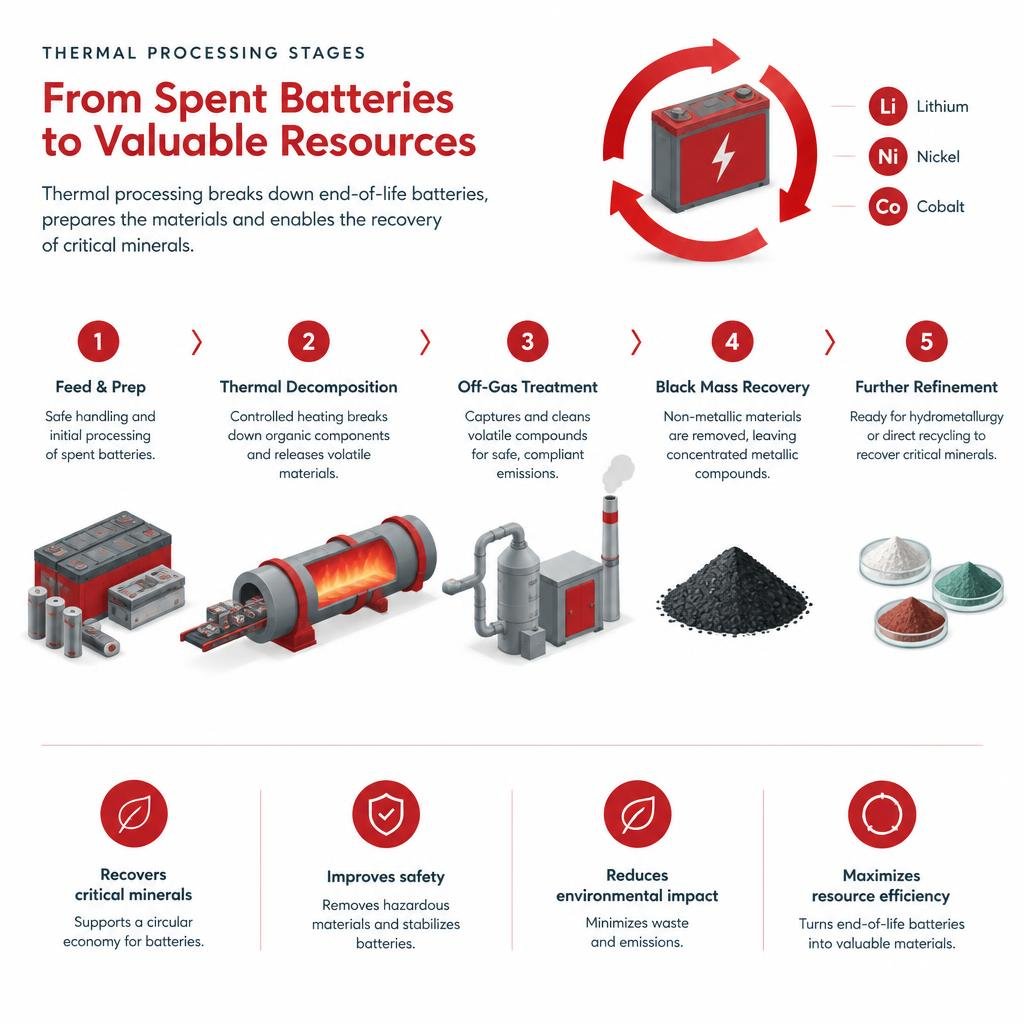
Rotary kilns, for example, are a common type of thermal processing equipment used in battery recycling. They provide a controlled environment for heating battery materials. As batteries move through the kiln, carefully managed temperature profiles initiate distinct phase transitions. In indirect-fired rotary kilns, precise indirect heat transfer allows for tight control of atmospheric gases, preventing uninhibited oxidation of graphite and other recoverable components. By maintaining an inert nitrogen purge, the kiln stabilizes volatile species while facilitating the continuous movement of feedstock. Organic components like binders, separators, and electrolytes undergo decomposition, volatilizing into gases that can be captured and treated. This process liberates the valuable metallic compounds, often referred to as “black mass,” from the non-metallic constituents. Understanding the thermal behavior of each battery component is crucial for designing processes that are both efficient and environmentally sound. Our goal is to recover as much material as possible while ensuring any off-gases are safely managed.
Pretreatment Mechanisms in Thermal Processing Systems
Before valuable metals can be extracted, spent batteries often require significant pretreatment. Thermal pretreatment is a critical step that prepares the battery components for subsequent hydrometallurgical or direct recycling processes. This stage focuses on safely breaking down organic materials and deactivating reactive components.
Binder pyrolysis is a key mechanism here. Polyvinylidene fluoride (PVDF), a common binder in lithium-ion battery cathodes, degrades at specific temperatures, releasing the active cathode material. Simultaneously, residual electrolytes, which are often flammable and toxic, undergo volatilization. This removes hazardous liquids and gases, significantly improving safety for downstream handling. Precise temperature profiling within the thermal processing unit is essential to optimize these reactions without damaging the valuable metal oxides. For instance, too high a temperature can lead to unwanted reactions or loss of lithium. Effective off-gas management systems are integral to capture and treat these volatile organic compounds, preventing environmental release.
Thermal Pretreatment Stages:
- Discharging: Safely reducing the battery’s electrical charge to prevent thermal runaway.
- Dismantling/Shredding: Physically breaking down battery packs and cells into smaller pieces.
- Drying: Removing residual moisture and some volatile electrolytes.
- Pyrolysis/Calcination: Heating in an inert or controlled atmosphere to decompose binders and carbon, and volatilize remaining electrolytes.
- Black Mass Separation: Mechanically separating the resulting “black mass” (a powder rich in active materials) from other materials like copper and aluminum foil.

Pyrometallurgical Smelting vs. Low-Temperature Pyrolysis
Within thermal processing, two primary approaches dominate: high-temperature pyrometallurgical smelting and lower-temperature pyrolysis. Each has distinct advantages and trade-offs concerning material recovery, energy intensity, and environmental impact.
Pyrometallurgical smelting, often conducted at temperatures exceeding 1400°C, aims to reduce metal oxides to their metallic forms or alloys. This process typically involves a smelting furnace where battery components are melted, often alongside fluxing agents. The high heat facilitates metal reduction, allowing valuable metals like cobalt, nickel, and copper to form a metallic alloy, while lithium, manganese, and aluminum often report to the slag phase. While effective at separating metals, smelting is energy-intensive and can lead to significant carbon emissions if not powered by renewable sources. It also requires robust off-gas scrubbers to manage sulfur dioxide and other gaseous byproducts.
In contrast, low-temperature pyrolysis (typically 400-800°C) focuses on decomposing organic components without melting the metals. This process is less energy-intensive and primarily yields a “black mass” rich in metal oxides, along with graphite and carbon. Pyrolysis is often a pretreatment step, preparing the material for subsequent hydrometallurgical extraction. It generates fewer direct metallic emissions but still requires careful management of volatile organic compounds. The choice between these methods, or a combination, depends on the specific battery chemistry, desired recovery products, and economic and environmental considerations.
Feature High-Temperature Smelting (Pyrometallurgy) Low-Temperature Pyrolysis Temperature Range >1400°C 400-800°C Primary Goal Metal reduction, alloy formation, slag separation Organic decomposition, black mass liberation, electrolyte volatilization Energy Intensity High Moderate Key Output Metal alloy (Co, Ni, Cu), slag (Li, Mn, Al), off-gases Black mass (metal oxides, graphite), off-gases Carbon Emissions Higher, due to high energy consumption and potential carbon reductants Lower, primarily from fuel for heating and organic decomposition Material Purity Metals often in alloy form, requiring further refining; slag contains impurities Black mass requires further hydrometallurgical processing for purity Environmental Impact Requires extensive off-gas treatment for SOx, NOx, and particulates Requires off-gas treatment for VOCs and fluorides Integrating Thermal Processing Systems with Hydrometallurgical Extraction
Thermal processing rarely stands alone in the battery recycling ecosystem; it is most effective when integrated into a comprehensive recycling workflow, particularly with hydrometallurgical extraction. This synergy allows for the efficient recovery of high-purity materials.
After thermal pretreatment, which liberates the black mass and removes hazardous organic compounds, the material is ready for hydrometallurgy. This chemical process involves dissolving the metal-rich black mass in aqueous solutions, typically strong acids. This step allows for the precise separation and recovery of individual metals. For instance, selective leaching can target lithium, cobalt, and nickel ions, leaving behind impurities. Advanced filtration and solvent extraction techniques then purify these metal solutions, leading to the precipitation of high-purity salts or oxides that can be directly reused in new battery manufacturing.
The efficiency of this combined approach hinges on the quality of the thermal pretreatment. Well-prepared black mass, free from organic contaminants and with a favorable particle size, significantly improves leaching kinetics and overall recovery rates. Modern recycling facilities are increasingly adopting sophisticated thermal processing equipment to optimize this initial step. This ensures that the subsequent hydrometallurgical stages can achieve maximum lithium recovery and high transition metal purity, contributing to a truly closed-loop material flow.

Technical Innovations and Operational Best Practices for Next-Generation Recovery
The battery recycling industry is rapidly evolving, driven by the increasing volume of end-of-life batteries and stricter regulatory requirements. Technical innovations are focusing on process intensification, closed-loop engineering, enhanced energy efficiency, and sophisticated system automation to meet these demands.
Process intensification aims to reduce the footprint and complexity of recycling operations by combining multiple steps or accelerating reaction rates. This can involve novel reactor designs or advanced catalysts. Closed-loop engineering is crucial for minimizing waste and maximizing material utilization, ensuring that byproducts from one stage become inputs for another. For example, water and reagents used in hydrometallurgy can be recycled and reused. Modern recuperative thermal units can capture sensible heat from off-gas streams to preheat incoming feedstocks or combustion air, significantly lowering overall operating costs and fossil fuel consumption.
Energy efficiency is a continuous area of improvement, as both pyrometallurgical and hydrometallurgical processes can be energy-intensive. Innovations include waste heat recovery systems, optimized furnace designs, and the use of renewable energy sources. Furthermore, system automation, leveraging artificial intelligence and advanced sensors, is transforming recycling facilities. Automated sorting, continuous infrared thermography for tracking internal reaction zones, real-time monitoring of process parameters, and robotic handling of hazardous materials not only increase efficiency and safety but also enable the processing of diverse battery chemistries with minimal human intervention. These operational best practices are essential for scaling up recycling capacity to handle the projected millions of end-of-life EV batteries by 2040.
Emission Control and Fluoride Gas Abatement
One of the most critical aspects of thermal processing in battery recycling is managing emissions, particularly fluoride gases. Lithium-ion batteries contain fluorinated compounds, such as polyvinylidene fluoride (PVDF) binders and lithium hexafluorophosphate (LiPF₆) electrolytes. When heated, these can decompose to release highly corrosive and toxic hydrogen fluoride (HF) gas.
Effective emission control strategies are paramount for environmental compliance and worker safety. This involves several layers of protection. Off-gas systems are designed to capture volatile compounds released during pyrolysis or calcination. Hydrogen fluoride capture typically employs dry or wet scrubbing systems, where gases are passed through a neutralizing agent (e.g., lime slurry) to convert HF into a stable salt. Thermal oxidizers can be used to destroy other volatile organic compounds (VOCs) by burning them at high temperatures. Off-gas condensation systems recover water and other condensable vapors. Additionally, sophisticated particulate filtration, such as baghouses or electrostatic precipitators, ensures that any fine dust or aerosols are removed before gases are released into the atmosphere. Continuous monitoring of emissions is standard practice to ensure strict adherence to environmental regulations.
Adaptation for Solid-State and Alternative Battery Chemistries
While current recycling technologies primarily focus on traditional lithium-ion chemistries like NMC, LFP, and LCO, the rapid evolution of battery technology necessitates adaptable recycling solutions. Future battery chemistries, such as solid-state and sodium-ion batteries, present new challenges and opportunities for thermal processing.
Solid-state batteries, for instance, replace liquid electrolytes with solid ones, potentially reducing fire risks but introducing new materials that may require different thermal decomposition profiles. Their ceramic or polymer solid electrolytes will demand tailored thermal treatments to separate them from active materials without degradation. Sodium-ion batteries, gaining traction as a lower-cost alternative to lithium-ion, will also need dedicated recycling pathways. While some existing thermal processes might be adaptable, the specific thermal stability and decomposition products of sodium compounds will need careful consideration.
Innovations in direct relithiation, where degraded cathode materials are directly regenerated through thermal sintering and relithiation steps, are also promising for future chemistries. Modular kilns and flexible thermal processing units, capable of adjusting temperature, atmosphere, and residence time, will be crucial for handling the diverse material compositions and ensuring chemical flexibility. This forward-looking approach ensures that as battery technology advances, our recycling capabilities can keep pace, maintaining a robust circular economy for all energy storage solutions.