Introduction
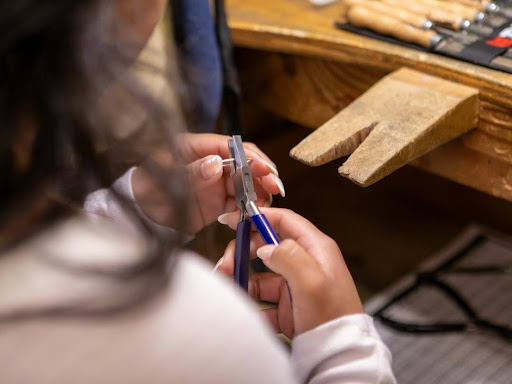
Imagine owning a piece of jewellery that is truly one-of-a-kind, designed to perfectly reflect your unique story or celebrate a special occasion. This is the essence of custom jewellery design – transforming a vision into a tangible treasure.
In a world of mass production, bespoke jewellery offers an unparalleled path to personal expression. It allows for the creation of items that are not only beautiful but also deeply meaningful, often incorporating ethically sourced materials like Canadian diamonds.
This extensive guide will take you through the entire journey of crafting custom jewellery. We will explore the distinct advantages of choosing Canadian diamonds, known for their strict ethical and environmental standards. We will also detail the creative process, from initial design consultation to the final creation of exquisite premium custom jewellery. Finally, we will help you understand how to evaluate the quality and lasting value of your personalized diamond piece.
Sourcing Ethical Gems: The Canadian Diamond Advantage
When embarking on the journey of custom jewellery design, the choice of gemstone is paramount. For those who prioritize ethical sourcing and environmental stewardship, Canadian diamonds stand out as an exceptional choice. Canada has rapidly ascended to become one of the world’s leading diamond producers, distinguishing itself not just by volume and value, but by an unwavering commitment to responsible mining practices. By September 2026, Canada contributes over 15% of global diamond production by value, firmly establishing its position among the top three producers worldwide.
The story of Canadian diamonds is relatively recent, with commercial mining only beginning in the 1990s following significant discoveries in the Northwest Territories. This late entry into the global diamond market allowed Canada to establish an industry built on modern principles of sustainability and ethical governance from the outset. Unlike some older mining regions, Canadian operations were developed with a keen awareness of their environmental and social impact, setting a new benchmark for the industry.
Mines such as Ekati, Diavik, and Gahcho Kué, predominantly located in the remote and pristine Arctic regions of Canada, are not merely sites of extraction. They represent a concerted effort to balance economic prosperity with ecological preservation. These operations are often accessible only by air or seasonal ice roads, underscoring the logistical challenges and the advanced planning required to maintain their high standards. This commitment ensures that rough diamonds from Canada are synonymous with integrity and responsible sourcing, offering a clear conscience alongside unparalleled beauty for your custom jewellery.
Origins and Environmental Standards in Canada
The unique appeal of Canadian diamonds stems directly from their origins and the rigorous standards governing their extraction. Canada’s diamond mines operate under some of the strictest environmental and social regulations globally. This commitment is deeply embedded in the mining process, from initial exploration to mine closure and reclamation. In 2024, Canada produced 13.3 million carats of diamonds, valued at $1.47 billion, making it the world’s fourth-largest producer by volume. This production is achieved with a focus on minimizing ecological footprints.
A cornerstone of Canadian diamond mining is the comprehensive environmental assessment process, which often employs a “triple bottom line” or “Five Capital” approach. This holistic evaluation considers not only financial returns but also social and environmental impacts. Wildlife protection is a critical component, with extensive measures taken to safeguard vulnerable Arctic ecosystems and their inhabitants, including caribou herds and grizzly bears. Water monitoring programs are meticulously implemented to prevent contamination and preserve the health of surrounding lakes and rivers, ensuring that water chemistry changes are carefully tracked and mitigated.
Beyond environmental considerations, Canadian diamond mines are pioneers in social governance. Strong partnerships with Indigenous communities are fundamental, ensuring that local populations benefit directly from mining operations through employment, training, and business opportunities. These collaborations extend to decision-making processes, providing Indigenous groups a voice in how resources are managed and how the land is protected. This integrated approach ensures that every Canadian diamond not only meets high quality standards but also carries a story of ethical production and community empowerment, making it a truly responsible choice for custom jewellery.
Traceability and Diamond Certification
One of the most compelling reasons to choose Canadian diamonds for custom jewellery is the unparalleled level of traceability and certification they offer. In a market where origin can sometimes be opaque, Canadian diamonds provide a transparent and verifiable journey from mine to market. This commitment to transparency directly addresses concerns about ethical sourcing and ensures consumers can be confident in their purchase.
The Canadian government plays a crucial role in regulating the diamond industry, implementing stringent export controls and tracking mechanisms. Most Canadian diamonds are accompanied by official government certificates of origin, providing definitive proof of their Canadian provenance. This certification is often complemented by laser inscriptions on the girdle of the diamond itself, which may include a unique serial number and a Canadian symbol, such as a maple leaf or polar bear. These inscriptions are microscopic and do not affect the diamond’s brilliance or value but serve as an indelible mark of its origin.
Furthermore, the industry is increasingly embracing advanced technologies like blockchain tracking. This innovative approach creates an immutable digital ledger of a diamond’s journey, recording every transfer of ownership and processing step. This provides an unprecedented level of provenance verification, allowing consumers to trace their diamond’s history with complete confidence. Gemological audits are also a standard practice, ensuring that diamonds meet specified quality and ethical standards throughout the supply chain. This robust system of origin mapping and certification means that when you select a Canadian diamond for your custom piece, you are choosing a gem with a clear, ethical, and verifiable story, aligning perfectly with the values of responsible luxury.
The Creative Process of Custom Jewellery Design
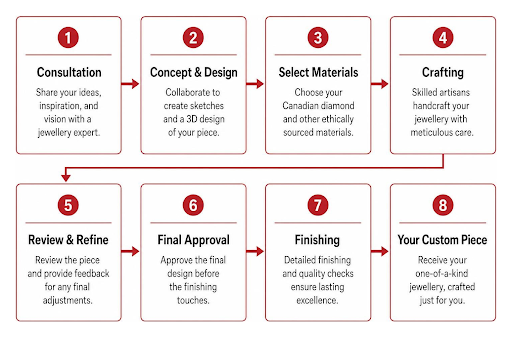
Crafting a piece of custom jewellery is an artistic collaboration, a journey where your personal vision is meticulously brought to life by skilled artisans. It’s a process that transforms abstract ideas into tangible elegance, ensuring the final product is not just an adornment but a deeply personal statement. The journey typically begins with an initial consultation, where we delve into your inspirations, preferences, and the story you wish your jewellery to tell.
This initial dialogue is crucial. We discuss everything from the occasion and the wearer’s style to preferred metals, gemstones, and design aesthetics. Whether you envision a classic solitaire engagement ring, a contemporary pendant, or a unique pair of earrings, the custom design process is tailored to your specific desires. From this foundation, our designers begin to translate your ideas into preliminary sketches, offering a visual representation of the emerging concept.
The beauty of custom design lies in its iterative nature. You are an integral part of every step, providing feedback that refines the design until it perfectly aligns with your expectations. This collaborative approach ensures that the final piece is not just expertly crafted but also resonates deeply with your personal narrative, making it an heirloom to be cherished for generations.
Translating Concept into Custom Jewellery Blueprints
Once the initial design concept takes shape, the next phase involves translating these ideas into precise blueprints. This is where artistry meets engineering, utilizing modern technology to ensure accuracy and structural integrity. The preliminary sketches evolve into detailed 3D visualizations, often created using Computer-Aided Design (CAD) software. These digital models provide a realistic rendering of the proposed piece, allowing you to view it from every angle and make informed decisions about proportions, dimensions, and aesthetic details.
The CAD process is invaluable for several reasons. It allows for meticulous adjustments to be made before any physical work begins, saving time and resources. You can see how different elements interact, how light might play off the facets of a diamond, or how the piece will sit on the hand. Following CAD approval, a physical wax model is often created using 3D printing technology. This tactile model offers a tangible representation of the design, allowing you to experience its weight, feel, and ergonomic fit. This step is critical for ensuring comfort and wearability, especially for pieces like rings that will be worn daily.
Our artisans then review these blueprints, combining digital precision with traditional hand fabrication techniques. They consider every detail, from the selection of appropriate casting techniques to the intricate hand-finishing that brings the piece to life. This meticulous approach ensures that the final custom jewellery piece is not only visually stunning but also structurally sound and built to last.
Selecting Gemstones and Metals for Custom Jewellery
The choice of gemstones and metals is pivotal in defining the character and value of your custom jewellery. For Canadian diamonds, a wide range of shapes, sizes, and qualities are typically available, allowing for immense creative freedom. Whether you prefer the classic brilliance of a round cut, the elegant lines of an emerald cut, or the romantic appeal of a heart shape, Canadian diamonds can be sourced to meet diverse aesthetic preferences. Sizes range from delicate accent stones to impressive carats, each selected for its unique characteristics.
When selecting your diamond, we delve into the “4 Cs” – cut, color, clarity, and carat weight – to find the perfect stone that aligns with your budget and vision. The cut precision is particularly important, as it dictates how brilliantly the diamond reflects light. For metals, the options are equally diverse, each offering distinct properties and aesthetics. Platinum, a naturally white and incredibly durable metal, is a popular choice for its strength and hypoallergenic qualities, providing a secure setting for precious diamonds. Yellow gold, available in various purities (e.g., 14K, 18K), offers a timeless warmth, while rose gold, with its romantic pink hue, provides a contemporary and distinctive look.
The method of setting the diamond also plays a significant role in the final design. Prong settings maximize a diamond’s exposure to light, enhancing its brilliance, while bezel mountings offer superior protection and a sleek, modern aesthetic. Other options include pavé settings for a sparkling surface or tension settings for a minimalist, floating appearance. Our experts guide you through these choices, ensuring that the selected gemstones and metals not only complement each other beautifully but also contribute to the overall durability and longevity of your bespoke piece.
Evaluating Value: Diamond Quality, Grading, and Material Longevity
Understanding the value of a diamond goes beyond its initial sparkle; it encompasses its inherent quality, its ethical provenance, and its enduring durability. For custom jewellery, these factors are particularly important, as you are investing in a piece designed to last a lifetime and beyond. Canadian diamonds, with their documented origin and high standards, offer a foundation of trust and quality that is difficult to match.
The quality of any diamond, including those from Canada, is primarily assessed using the universal “4 Cs” grading system: Cut, Color, Clarity, and Carat Weight.
- Cut: This is perhaps the most crucial factor, as it determines a diamond’s brilliance, fire, and scintillation. An expertly cut diamond will maximize its light performance, regardless of its size or color.
- Color: Diamonds are graded on a scale from D (colorless) to Z (light yellow or brown). Canadian diamonds are found across this spectrum, allowing for selection based on personal preference and budget.
- Clarity: This refers to the absence of inclusions (internal flaws) and blemishes (external imperfections). Graded from Flawless (FL) to Included (I), clarity impacts a diamond’s purity and light passage.
- Carat Weight: This measures a diamond’s weight, not its size. Larger carats are generally rarer and thus more valuable, but an excellent cut can make a smaller diamond appear larger and more brilliant.
While there are no internationally set prices for rough gem-quality diamonds, the value of polished diamonds is heavily influenced by these grading factors. For instance, the average value per carat of world production was around US$88.35 in 2024, a decrease from previous years, reflecting market dynamics. However, the value of a specific gem-quality diamond is determined by its unique combination of the 4 Cs.
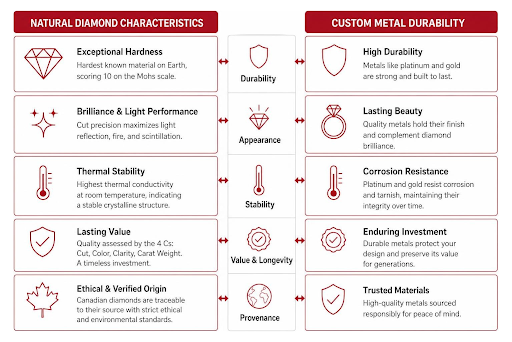
Beyond the 4 Cs, the inherent properties of diamonds contribute to their exceptional longevity. Diamonds are renowned as the hardest known material on Earth, scoring a perfect 10 on the Mohs scale of mineral hardness. This makes them incredibly resistant to scratching, ensuring that your custom piece will maintain its pristine appearance for decades. Furthermore, diamonds possess the highest thermal conductivity of any material at room temperature, a property that, while often utilized in industrial applications like heat sinks for electronics, also speaks to their robust and stable crystalline structure. This combination of hardness and stability makes Canadian diamonds an ideal choice for custom jewellery that is meant to be worn and cherished daily, offering both unparalleled beauty and lasting value.
Frequently Asked Questions About Bespoke Jewellery
How are Canadian diamonds verified for origin and ethical sourcing?
Canadian diamonds are verified through a multi-layered system designed for transparency and accountability. This typically includes official government certificates of origin, often accompanied by microscopic laser inscriptions on the diamond’s girdle. These inscriptions bear unique serial numbers and symbols, such as a maple leaf, directly linking the diamond to its Canadian mine. The entire process is subject to strict export controls, government tracking, and regular audit standards, ensuring compliance with ethical mining practices and environmental regulations. Additionally, many Canadian diamonds are now trackable via blockchain technology, providing an immutable digital record of their journey from mine to market.
What is the typical timeline for crafting bespoke diamond rings?
The timeline for crafting bespoke diamond rings can vary significantly depending on the complexity of the design, the availability of specific gemstones, and the current workload of the artisan. Generally, the process begins with a design consultation, which can take several sessions. Following this, the creation of CAD models and 3D renderings for client approval typically spans 1-2 weeks. Once the design is approved, the physical production phase, including wax model creation, casting, gemstone setting, and meticulous hand finishing, can take anywhere from 4 to 8 weeks. Therefore, clients should generally anticipate a total timeline of 6 to 12 weeks from initial consultation to the completion of their custom diamond ring.
How do Canadian diamonds compare in durability and brilliance to global gems?
Canadian diamonds possess the same exceptional durability and brilliance characteristics as high-quality natural diamonds found globally. Their cubic crystal structure makes them the hardest known material, scoring 10 on the Mohs hardness scale, making them highly resistant to scratches and damage. In terms of brilliance, Canadian diamonds, like all natural diamonds, exhibit a high refractive index, meaning they efficiently bend and reflect light. When cut to excellent proportions, this results in remarkable light performance, showcasing intense fire, sparkle, and scintillation. The origin of a natural diamond does not alter its fundamental physical properties; rather, it is the quality of its cut, color, and clarity that determines its visual appeal and durability, aspects for which Canadian diamonds are rigorously evaluated.
Conclusion
The journey of custom jewellery design is an intimate and rewarding experience, culminating in a piece that is as unique as the individual who wears it. By choosing Canadian diamonds, you are not only selecting a gem of extraordinary beauty and durability but also one that embodies a profound commitment to ethical sourcing and environmental stewardship. From the pristine Arctic landscapes where they are mined to the meticulous processes of design and craftsmanship, Canadian diamonds offer a clear conscience and an unparalleled narrative.
We have explored how the rigorous standards of Canadian mining operations ensure responsible practices, and how advanced traceability options provide complete transparency. We’ve also delved into the creative process, from initial inspiration to the final hand-finished masterpiece, highlighting how each step is tailored to bring your vision to life. The enduring value of custom craftsmanship, combined with the inherent quality and ethical provenance of Canadian diamonds, creates not just jewellery, but a personalized luxury that becomes an heirloom. Investing in a custom piece with Canadian diamonds is an investment in enduring beauty, ethical integrity, and a legacy designed to be cherished for generations.